



Halogen vs Infrared vs Karl Fischer: How to Choose a Moisture Analyzer
 Nov 12, 2026|
 View:13
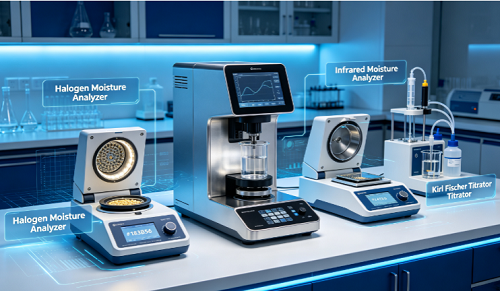
Why the Method Matters More Than the Model Number
Most buyers start by comparing capacities and displays, but moisture results are determined first by the measurement principle. A halogen analyzer and a Karl Fischer titrator can both report "0.5% moisture" on the same sample and still disagree, because they measure different things: loss on drying (LOD) captures everything that evaporates, while Karl Fischer titration captures water specifically. For a sample containing ethanol, acetic acid or essential oils, that difference is the entire result.
This guide compares the three technologies on the four criteria that actually decide a purchase — accuracy, speed, sample suitability and price — then maps them to the industries we supply every month. All specifications quoted for WANT instruments below come from our current product datasheets.
The Three Methods Side by Side
Table 1 — Halogen vs infrared vs Karl Fischer: capability and cost comparison
| Criterion | Halogen (LOD) | Infrared (LOD) | Karl Fischer (Titration) |
|---|---|---|---|
| Measurement principle | Thermogravimetric: sample is dried by a halogen lamp; mass loss = moisture | Thermogravimetric: IR lamp heats the sample, typically with deeper penetration | Coulometric or volumetric titration: iodine reacts stoichiometrically with water only |
| Typical moisture readability | 0.01% – 0.001% (10 mg–1 mg balance readability) | 0.01% – 0.001% | 0.001% – 0.0001% (10–1 ppm with coulometric cells) |
| Measuring range | ~0.1% – 100% | ~0.1% – 100% | 0.001% – 100% |
| Test time per sample | 3 – 15 min (method dependent) | 3 – 15 min, often slightly faster on dense samples | 1 – 3 min |
| What it actually measures | All volatiles (water + solvents + decomposition products) | All volatiles, with less surface scorching | Water only — no interference from solvents or volatiles |
| Best sample types | Grain, flour, starch, feed, food, plastic pellets, paper, textile, minerals | Denser or darker samples, slurries, samples prone to surface burn | Oils, lubricants, solvents, pharmaceuticals/APIs, lyophilized powders, plastics with low moisture |
| Sample preparation | Grind/spread; disposable pan | Grind/spread; disposable pan | Dissolve or extract in Karl Fischer reagent; no heating |
| Consumables | None beyond pans | None beyond pans | Reagents, standards, electrodes, drying tubes |
| Operator skill | Low | Low | Medium — method development and reagent handling |
| Indicative factory-direct price (FOB China, 2026) | US$200 – 900 | US$250 – 1,000 | US$1,500 – 4,000 (volumetric); US$2,500 – 6,000 (coulometric) |
How Each Method Works — and Where It Fails
1. Halogen Moisture Analyzers: The Workhorse
A halogen lamp heats the sample from above while a precision balance continuously records mass. When the mass stabilises, the instrument divides the loss by the initial sample mass and reports moisture percentage. Halogen lamps reach drying temperature quickly and deliver a relatively uniform heat profile across the pan, which is why they dominate routine QC in food, feed, grain and plastics.
Where it fails: Any sample containing volatile solvents, or samples that decompose before drying completely. The result will read high because you are weighing evaporated solvent, not just water. Samples with a skin-forming surface (dairy powders, syrups) also need a glass-fibre pad or a slower temperature ramp.
2. Infrared Moisture Analyzers: Same Logic, Different Heat Source
Infrared lamps penetrate deeper into the sample bed, so thick or dense samples dry more evenly and the surface is less likely to scorch. On materials such as whole grains, mineral powders and slurries, IR can shorten the cycle and reduce the "crust effect" that traps moisture in the centre of the sample.
Where it fails: The same limitation as halogen — it is still a loss-on-drying method. It also gives you less control over the heating curve on very heat-sensitive material, unless the instrument offers programmable temperature ramps.
3. Karl Fischer Titrators: Water-Specific Measurement
Karl Fischer titration uses the stoichiometric reaction between iodine and water. In a volumetric titrator, a reagent containing iodine is added until all water has reacted, and the volume consumed gives the water content directly. Because the chemistry only responds to water, the result is unaffected by alcohols, oils, solvents or volatile compounds that would inflate a loss-on-drying reading.
Where it fails: Samples that do not dissolve or disperse in the reagent, samples that react with iodine (some antioxidants, peroxides, ascorbic acid), and very high-moisture samples where a volumetric titre becomes impractical. Reagent cost and method development are real ongoing obligations.
Selection Matrix by Industry
Table 2 — Which analyzer for which industry
| Industry | Typical Samples | Recommended Method | Why |
|---|---|---|---|
| Food & beverage | Flour, starch, dairy powder, snacks, meat, coffee, tea, sugar | Halogen (MB series) | Fast routine QC, wide moisture range, low consumable cost; spec limits are usually 0.1–1% so LOD resolution is sufficient |
| Pharmaceutical | APIs, excipients, granules, lyophilized powders, capsules | Karl Fischer (AKF-1); halogen for incoming raw material screening | Pharmacopoeial methods (USP <921>, EP 2.5.12) are based on KF; water-specific results are required for release testing |
| Grain & agriculture | Wheat, rice, maize, soybean, feed, seeds | Portable grain cup meter (LDS-1G) for field/intake; halogen for lab reference | Whole-grain measurement without grinding; trade pricing and storage decisions need results in seconds at the intake point |
| Chemical | Solvents, resins, lubricants, powders, catalysts | Karl Fischer for solvents and oils; halogen/IR for powders and resins | Solvent-containing samples break LOD accuracy; powders are cheaper and faster by LOD |
| Plastics & polymers | Pellets, granules, masterbatch, film | Halogen/IR with grindable sample; KF for low-moisture engineering grades | Processing defects appear below 0.05% moisture, where LOD resolution runs out of margin |
| Paper, textile & wood | Pulp, yarn, fabric, sawdust, bamboo powder, board | Halogen for lab; needle meter (TK100W) for incoming wood and fibre | Bulky materials are impractical to bring to a lab; needle meters give instant on-site readings |
WANT Moisture Analyzer Range and Real Specifications
We build loss-on-drying analyzers, portable meters and Karl Fischer titrators in Changzhou, Jiangsu, and supply them to distributors and OEM customers in more than 100 countries. The specifications below are from current datasheets — no rounded marketing figures.
1. MB Series Halogen Moisture Analyzer (120 g Class)
Table 3 — MB series specifications
| Model | Capacity | Readability | Moisture Readability | Heat Source | Pan Size |
|---|---|---|---|---|---|
| MB1203 | 120 g | 1 mg | 0.01% | Halogen lamp | Φ100 mm |
| MB1203-5 | 120 g | 5 mg | 0.05% | Halogen lamp | Φ100 mm |
| MB1202 | 120 g | 10 mg | 0.10% | Halogen lamp | Φ100 mm |
Load-cell sensor, PT-1000 temperature sensor, heating up to 160 °C or 180 °C, operating range 5–35 °C. Suitable for chemicals, grain, minerals, biological products, food, pharmaceutical raw materials, paper and textile samples.
2. MA Series Touchscreen Analyzer (50 g / 120 g Class)
Table 4 — MA series specifications
| Model | Capacity | Readability | Heating | Heat Source | Dimensions |
|---|---|---|---|---|---|
| MB503T | 50 g | 1 mg | up to 180 °C | Halogen / infrared (optional) | 35 × 21 × 17 cm |
| MB503-2T | 50 g | 2 mg | up to 180 °C | Halogen / infrared (optional) | 35 × 21 × 17 cm |
| MB503-5T | 50 g | 5 mg | up to 180 °C | Halogen / infrared (optional) | 35 × 21 × 17 cm |
| MB1203T | 120 g | 1 mg | up to 180 °C | Halogen / infrared (optional) | 35 × 21 × 17 cm |
Touchscreen operation, Φ100 mm pan, recommended working environment 10–30 °C. The halogen/infrared option lets one platform cover both standard and dense samples.
3. AKF-1 Automatic Karl Fischer Titrator
Table 5 — AKF-1 specifications
| Parameter | Value |
|---|---|
| Moisture range | 0.001% – 100% |
| Titration control accuracy | 1.0 µL |
| Titration repeatability | 99.7% at 10 mg water (manufacturer figure) |
| Measurement time | < 3 minutes average |
| Electrode | Double platinum plate |
| Interface / data storage | Button LCD; 10 data groups |
| Operating humidity | ≤ 80% |
| Power | 110/220 V, 50 Hz |
| Dimensions / weight | 320 × 240 × 410 mm / 5.5 kg |
Fully automatic operation with stoichiometric water-specific results, intended for oils, solvents, pharmaceutical raw materials and other heat-sensitive samples.
4. Portable Meters: Grain Cup and Needle Type
Table 6 — Portable meter specifications
| Model | Type | Range | Notes |
|---|---|---|---|
| LDS-1G | Grain cup | 3% – 35% | Displays average value, volume weight, moisture, weight and temperature; working environment 0–40 °C |
| TK100W | Needle | Wood / fibre | For sawdust, bamboo powder and particle board; used in paper making, furniture and charcoal production |
Portable meters are not substitutes for lab analyzers — they are for intake screening, trading decisions and field checks. Pair them with a lab analyzer for dispute resolution.
What Moisture Analyzer Prices Actually Depend On
Buyers often ask why one 120 g analyzer costs US$250 and another US$900. In factory-direct terms, five factors drive the gap:
Balance readability. A 1 mg (0.01% moisture) instrument needs a higher-grade load cell and better thermal compensation than a 10 mg (0.10%) unit. This is the single largest cost lever.
Heating control. Fixed-power lamps are cheap; programmable ramps, dual halogen/IR sources and accurate PT-1000 feedback are not.
Interface and data. Touchscreens, RS232/printer output, method memory and GLP printouts add cost but are often mandatory in regulated plants.
Calibration and certification. ISO 9001 production, CE/RoHS compliance and calibration certificates with traceable weights are priced in.
After-sales scope. Spare lamps, pans and sensor modules, plus response time and warranty length, differ substantially between suppliers.
Four Checks Before You Sign a Purchase Order
Repeatability, not just readability. Ask for three consecutive results on the same sample. Readability is a display digit; repeatability is whether you can trust a pass/fail decision.
Method comparison. Run your own sample against a reference method (oven method or KF) before accepting the instrument. Temperature setting alone can shift LOD results by 0.3%.
Sample preparation procedure. Grinding, spreading and glass-fibre pads change results more than most instrument specs. Require a written SOP with the quotation.
Calibration traceability. Confirm the instrument ships with a calibration certificate and that certified weights are available locally — this matters at audit time.
Need a Method Recommendation for Your Sample?
Send us your material type, expected moisture range and required resolution. Our application team replies within 24 hours with a recommended model, an indicative factory-direct price and a sample test report.
OEM and ODM configurations — including your brand, voltage, language and packaging — are available from 20 years of balance manufacturing in Changzhou, Jiangsu.
Request a Moisture Analyzer Quotation →Browse All Moisture Analyzers →Frequently Asked Questions
1. Is a Halogen Moisture Analyzer as Accurate as Karl Fischer?
Not for water-specific measurement. Halogen analyzers are thermogravimetric and report all volatiles, so a solvent-containing sample reads high. For dry, heat-stable solids the two methods agree closely; for oils, solvents and APIs, Karl Fischer is the reference method and is required by pharmacopoeial testing.
2. How Much Does a Moisture Analyzer Cost?
Factory-direct from China in 2026: US$200–400 for a 0.05–0.10% halogen analyzer, US$450–900 for a 0.01% model with touchscreen, US$1,500–4,000 for a volumetric Karl Fischer titrator, and US$50–150 for a portable grain meter. Branded imports cost 3–6× more for comparable specifications.
3. How Long Does One Moisture Test Take?
Halogen and infrared analyzers typically need 3–15 minutes depending on sample mass, temperature and moisture level. Karl Fischer titration averages under 3 minutes. Method optimisation usually shortens a halogen cycle more than buying a faster instrument.
4. Can I Measure Moisture in Plastic Pellets with a Halogen Analyzer?
Yes, for screening at 0.01% resolution. For engineering grades where the specification sits below 0.05%, use Karl Fischer, because loss-on-drying resolution runs out of margin and volatile additives can inflate the reading.
5. Do I Need Both a Halogen Analyzer and a Karl Fischer Titrator?
Many QC labs do. Halogen handles high-volume routine samples quickly and cheaply; Karl Fischer is kept for release testing, low-moisture products and dispute resolution. The split typically follows the specification limit rather than the product family.
6. What Is the Difference Between Infrared and Halogen Heating?
Both are loss-on-drying methods. Halogen lamps heat fast and evenly across the pan; infrared penetrates deeper into the sample bed, which helps with dense or crust-forming materials. The choice affects cycle time and surface scorching, not the measurement principle.
7. Why Does My Analyzer Disagree with the Oven Method?
Usually three causes: drying temperature set too high (volatiles or decomposition), incomplete drying because the endpoint criterion is too loose, or sample preparation differences. Run a temperature ramp test to find the plateau where results stabilise, then lock that method into the SOP.
Looking for a Reliable Moisture Analyzer Manufacturer?
WANT Balance Instrument Co., Ltd. supplies moisture analyzers, Karl Fischer titrators and portable moisture meters for laboratories, manufacturers and distributors worldwide.
Contact Our Sales Team →