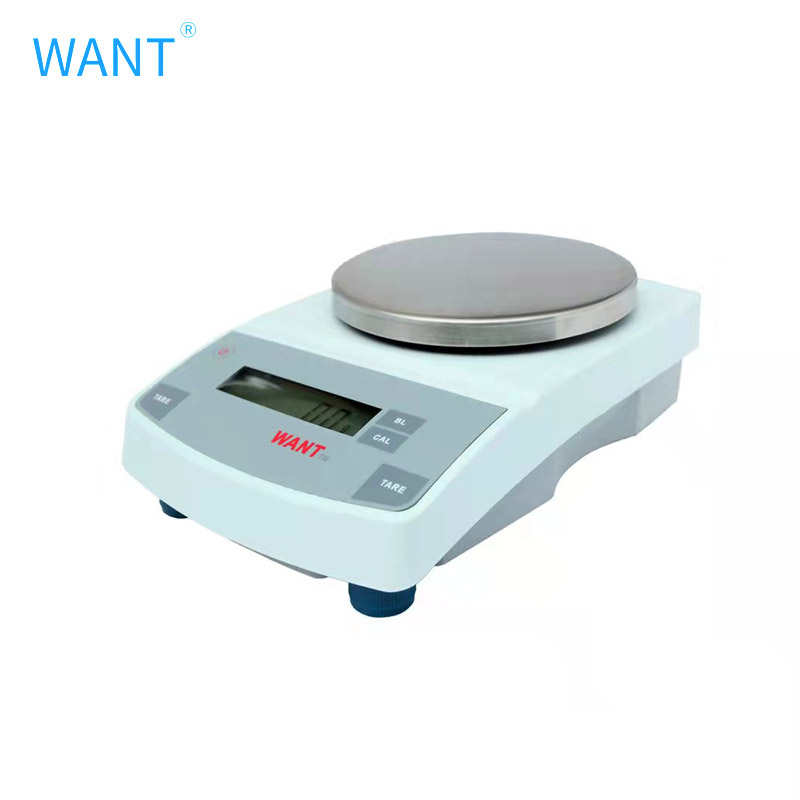




How To Use An Electronic Balance In Chemistry Lab?
 Jun 24, 2025|
 View:2559
In chemical laboratories, the electronic balance is a core device for obtaining accurate measurement data, and its precision directly affects the reliability of experimental results. From weighing trace reagents to preparing standard solutions, the operational specifications and maintenance requirements of electronic balance for laboratory form the foundation of experimental success. This article systematically analyzes the full operation process and technical key points of electronic balances in chemical laboratories to ensure every weighing is accurate and trustworthy.

Critical Preparations Before Use
1. Level Adjustment: The First Step to Ensure Precision
· Spirit Bubble Calibration: Before turning on the balance, observe the position of the bubble in the base level gauge. If the bubble deviates from the center of the circular mark, rotate the foot screws (left to raise, right to lower) until the bubble is centered. Horizontal deviation causes gravitational force component errors, especially significant for 0.1mg high-precision balances.
· Vibration-Resistant Table Selection: Avoid placing the balance near doors/windows or vibration sources (e.g., centrifuges, shakers). Prioritize concrete tables or specialized anti-vibration workbenches.
2. Preheating and Stability Control
· 30-Minute Preheating Rule: For the first boot or restart after power failure, preheat for ≥30 minutes. Before circuit components stabilize in temperature, the sensor is prone to zero drift, causing reading fluctuations.
· Standby Mode Management: For short stops (<2 hours), keep the power on and only turn off the display to avoid repeated preheating.
3. Calibration Operation Specifications
· External Calibration Process:
· Press the TAR key to zero;
· Long-press the CAL key until the screen displays "CAL-100";
· Place a 100g standard weight at the center of the weighing pan;
· Wait for automatic calibration to complete, displaying "100.0000g";
· After removing the weight, "0.0000g" indicates effective calibration.
· Calibration Frequency Requirements: Re-calibrate after position movement, sudden environmental temperature/humidity changes (>5℃ or >15% humidity variation), or continuous use for 1 month.
Detailed Explanation of Core Weighing Operation Techniques
1. Direct Weighing
· Suitable Objects: Gross weight measurement of non-deliquescent solids like crucibles and beakers;
· Operation Process:
· Zero the balance, open the side door, and place the container;
· Close the windproof door and read the value after it stabilizes.
2. Fixed Mass Weighing
· Application Scenarios: Accurately obtaining a fixed mass (e.g., 0.5000g) of stable powders;
· Operation Key Points:
· Tare the container (TAR key);
· Add samples gradually with a horn spoon, tapping the handle to let samples fall slowly;
· When approaching the target mass, use the "flicking method" (1-2 light taps per second) for fine adjustment.
3. Weight by Difference
· Necessity: Weighing hygroscopic or oxidizable samples (e.g., NaOH, anhydrous CaCl₂);
· Steps:
· Weigh the initial mass m₁ of the weighing bottle (with samples) and zero;
· Pour part of the sample into the receiving container;
· Place the weighing bottle back to get the remaining mass m₂;
· Net sample weight = m₁ - m₂.
Key Precautions and Error Control
1. Prevention of Environmental Interference
· Airflow Isolation: Close the side doors of the windproof cover, and ensure the air conditioning outlet wind speed is<0.2m/s;
· Temperature and Humidity Control: Temperature fluctuation ≤2℃/h, humidity maintained at 40%-60%. Excessive humidity causes static adsorption, and temperature gradients induce electromagnetic force drift.
2. Operation Specifications
· Anti-Pollution Measures:
· Corrosive substances (acids, bromine) must be weighed in sealed containers;
· Powder samples require weighing paper, and spills should be cleaned immediately with alcohol cotton;
· Center Placement Principle: Place samples at the geometric center of the weighing pan. Deviation >5mm can cause a 0.2mg error.
3. Daily Maintenance Key Points
· Cleaning Procedures: Wipe the weighing pan daily with alcohol cotton (anhydrous ethanol); avoid using organic solvents to clean the shell;
· Desiccant Management: Replace silica gel when it changes color (pink→blue), and place it away from the weighing area.
Common Fault Troubleshooting Guide
Fault Phenomenon | Possible Cause | Solution |
Reading drift | Airflow disturbance/temperature-humidity sudden change | Close the windproof cover/stabilize the environment for 30 minutes |
Display "------" | Overload (>Max 220g) | Unload immediately and check the mass of the sample container |
CAL failure | Weight not placed correctly/level unbalanced | Re-level and place the weight at the center |
Unstable zero point | Residual particles on the pan/static electricity | Clean with alcohol cotton and remove static electricity with an ion fan |
Conclusion: The Cornerstone of Precision Measurement
In every link of chemical analysis—from standardizing titration solutions to charging in synthesis reactions—the standardized operation of electronic balances directly determines data reliability. Electronic balance for laboratory is not just instruments but the starting point of the experimental logic chain. Following the three-level operation specifications (preparation→weighing→maintenance) can minimize systematic errors and ensure experimental reproducibility.
Choosing an electronic balance supplier with ISO 17025 certification is key to obtaining long-term stable services and technical support. WANT provides a full range of laboratory precision balances, covering precision requirements from 0.1mg to 0.01g, and is equipped with on-site calibration and operation training services to help you establish trustworthy weighing standards.