



Types of Electronic Balances in the Laboratory
 Nov 18, 2026|
 View:10
Choosing an Electronic Balance for laboratory work is rarely a question of the finest display alone. An Analytical Balance, a Precision Balance and a Moisture Analyzer (Moisture Balance) each answer a different question about a sample, and the wrong class can turn a routine weighing into a source of avoidable uncertainty. This guide explains how each type works, what its numbers mean and where each one is normally specified.
Key Takeaways
An Electronic Balance is the broad family of instruments that convert mass into an electrical reading.
An Analytical Balance is normally specified at 0.1 mg readability and uses a draft shield for quantitative work.
A Precision Balance covers routine weighing at about 1 mg to 10 mg with larger capacities and open pans.
A Moisture Analyzer (Moisture Balance) adds a heating unit so mass loss during drying can be reported as moisture content.
How an Electronic Balance Works: Readability, Capacity and Sensing
An Electronic Balance replaces the mechanical beam and pointer with a sensor and a digital display. In many laboratory instruments the pan is connected to a coil suspended in a magnetic field. When a sample pushes the pan down, a position sensor detects the displacement and the circuitry increases current through the coil until the pan returns to its original position. The current needed to restore that position is proportional to the mass. A university level explanation of this electromagnetic force restoration principle used in laboratory weighing also notes that a typical instrument holds roughly 100 g to 200 g and reads to between 0.01 mg and 1 mg.
Two numbers frame every specification. Readability is the smallest change the display can show, while capacity is the heaviest load the pan can accept. They move in opposite directions in practice: a balance that resolves 0.1 mg usually has a modest capacity, whereas an Electronic Balance built for kilogram loads shows grams or tenths of a gram. A third idea, repeatability, describes how closely repeated weighings of the same object agree; a fine display by itself does not ensure a dependable result.
Calibration links the reading to known reference weights. Because local gravity changes with location and altitude, instruments that measure at sub milligram levels need adjustment after a move or a change in environment. National metrology publications describe how accuracy requirements and tolerances are framed for weighing instruments, while routine laboratory practice uses certified weights traceable to a mass standard.
Main Types of Laboratory Electronic Balances
The family is usually divided by readability and intended task rather than by appearance. The four categories below cover the instruments most often specified for laboratory work, from quantitative analysis to rapid moisture testing; the electronic balance product categories show how these classes are grouped in practice.
Analytical Balance: Fine Readability for Quantitative Work
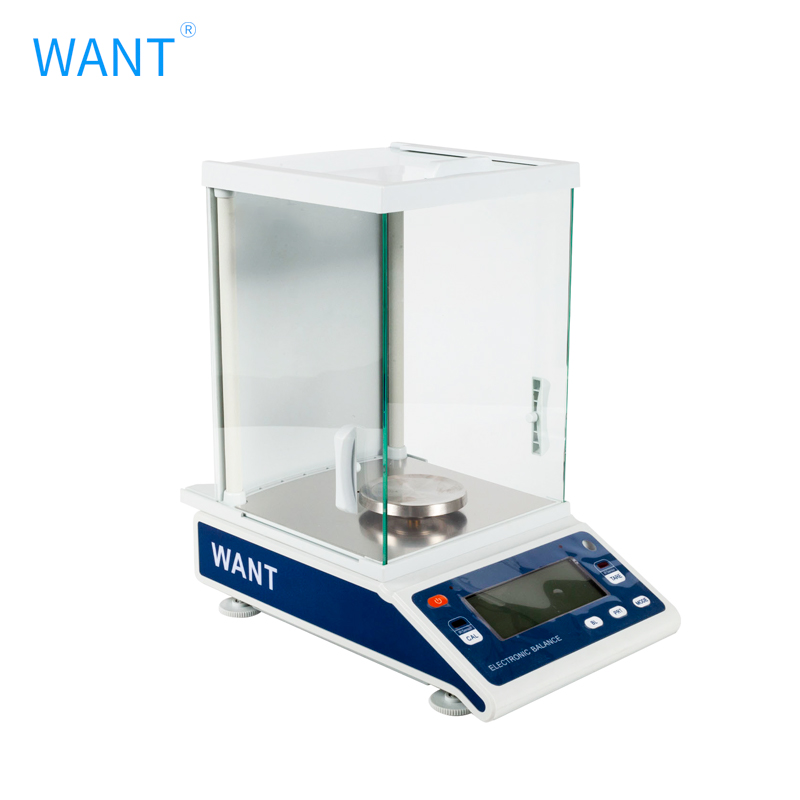
An Analytical Balance is designed for small masses and small differences between masses. A readability of 0.1 mg, written 0.0001 g, is the conventional reference point, and general reference material on analytical balance construction and the role of the draft shield describes the transparent enclosure that keeps dust and room air currents away from the pan. The same source explains that electronic instruments generate a counterforce electromagnetically rather than balancing a beam against reference masses.
Typical uses include preparing standard solutions, quantitative chemical analysis, pharmaceutical formulation and weighing small reference quantities. At this resolution a fingerprint or a warm container can change the reading, so samples are handled with clean tools, brought to room temperature and weighed with the shield closed. Models with 0.01 mg readability are sometimes grouped with semi micro instruments, while instruments reaching 1 µg belong to the microbalance class. Readers comparing specific configurations can review the 0.1 mg analytical balance series as one published example of this category.
Precision Balance: Routine Weighing at Moderate Readability
A Precision Balance, often called a top loading balance, uses an open pan and reads to roughly 0.001 g to 0.01 g in common laboratory models. It is faster to use than an enclosed instrument because vessels can be placed and removed without opening a shield. Sample preparation, media preparation, formulation, counting and routine quality control are frequent applications.
The trade off is resolution for range. A Precision Balance may hold hundreds of grams, several kilograms or, in heavier bench and platform versions, tens of kilograms. That makes it suitable for larger vessels and bulk components that would overload an Analytical Balance. Draft shields are less common, although they can appear on finer models, and environmental control is still needed when the display reaches the milligram level.
Semi Micro and Micro Balance Classes
Semi micro instruments sit between the standard analytical class and the microbalance. A commonly cited readability is 0.01 mg, written 0.00001 g, with capacities that remain more practical than most micro instruments. They are used for low dose pharmaceutical work, reference material preparation and research samples available only in small quantities.
A microbalance reaches about 1 µg, or 0.000001 g, and a general description of microbalance measuring range confirms the millionth of a gram scale. At that level vibration, draughts, static charge and temperature drift become part of the measurement problem. Controlled rooms, anti vibration tables, ionisers and careful sample handling are normal requirements, which is why these instruments are specified for trace analysis, filter weighing and advanced materials research rather than general bench work.
Moisture Analyzer (Moisture Balance): Weighing During Drying
A Moisture Analyzer (Moisture Balance) combines a weighing system with a heating element, commonly a halogen lamp. The sample is weighed, heated and weighed again while drying proceeds. The instrument reports the mass lost as a percentage of the original sample, a loss on drying result that replaces a separate oven and repeated manual weighings. The underlying idea matches the measurement of sample mass as temperature changes used in thermal analysis.
This class is specified for food, grain, pharmaceuticals, minerals, paper, textiles and polymer raw materials. A moisture balance answers a process question rather than a pure mass question, so the result depends on drying temperature, sample thickness and the endpoint rule as well as the weighing sensor. Materials that contain volatile solvents or decompose when heated need method validation before the figure is treated as water content alone. Published manufacturer data for one 120 g instrument list 1 mg, 5 mg and 10 mg readability options, moisture readability from 0.01% to 0.10% and halogen heating up to 160 °C or 180 °C; a laboratory moisture balance product range illustrates the configurations available.
The following examples show how these classes appear in a real catalogue: a fine readability analytical instrument, a milligram level bench instrument and a dedicated drying based analyser.

FA Series Electromagnetic 0.1mg Analytical Balance
Electromagnetic force sensing, a four sided glass shield and models from 60 g to 220 g at 0.1 mg readability.
View Product
WT-CH Series 1mg Electronic Balance
A 0 g to 300 g capacity with 0.001 g readability, an anti static windshield and an RS232 interface.
View Product
MB Series 120g Moisture Analyzer
Halogen drying with 120 g capacity, readable mass steps from 1 mg to 10 mg and moisture readability from 0.01%.
View ProductChoosing the Right Electronic Balance for the Task
Start with the smallest mass that must be weighed accurately, then add the weight of the container and a safety margin to set capacity. A Precision Balance is normally sufficient when the smallest portion is well above a few milligrams. An Analytical Balance becomes relevant when the working mass is small enough that 0.1 mg matters, and quantitative methods usually define a minimum sample weight rather than relying on display increments alone.
Environment is the second filter. An Analytical Balance needs a level, stable bench away from doors, vents and vibration sources; a semi micro or micro instrument adds stricter control of static and temperature. A Moisture Analyzer is chosen when the output required is percentage moisture rather than a net mass, and the method must suit the thermal behaviour of the sample. A Moisture Balance does not replace a microbalance for trace mass work, just as a microbalance cannot report drying loss.
Finally, check the practical details: calibration mode, pan size, interface, cleaning access and the availability of documented specifications. Laboratories that weigh across very different mass ranges often keep two instruments instead of asking one balancing instrument to cover every task.
Review Balance Options Before Specifying
Category overviews, calibration guidance and product specifications can be reviewed when comparing instrument classes.
Specification Comparison of Analytical Balance, Precision Balance and Moisture Analyzer (Moisture Balance) Types
The table below collects representative values. Ranges describe the classes in general terms; rows tied to a named model report manufacturer published figures.
| Balance type | Typical readability | Typical capacity | Distinguishing feature | Common use |
|---|---|---|---|---|
| Analytical Balance | 0.1 mg (0.0001 g) | 60 g to 220 g in the listed FA series | Enclosed draft shield and electromagnetic force sensing | Standard solutions, quantitative analysis |
| Semi micro balance | 0.01 mg (0.00001 g) | Low tens to low hundreds of grams | Finer resolution than a standard analytical instrument | Low dose formulations, reference materials |
| Microbalance | 1 µg (0.000001 g) | Typically a few grams to about 20 g | Controlled vibration and draught free environment | Trace analysis, filter weighing |
| Precision Balance | 0.001 g to 0.01 g | 300 g for the WT-CH example; larger bench models reach tens of kilograms | Open top loading pan and faster handling | Sample preparation, formulation, quality control |
| Moisture Analyzer (Moisture Balance) | 1 mg, 5 mg or 10 mg in the MB series | 120 g in the listed MB series | Integrated halogen heating and loss on drying calculation | Food, grain, pharmaceuticals, raw materials |
Request Technical Documentation
Model level data sheets and direct channels are available for checking capacity, readability and drying performance.
Conclusion
An Electronic Balance is a family of instruments, not a single specification. The Analytical Balance serves quantitative work at 0.1 mg, the Precision Balance covers routine weighing with more capacity, semi micro and micro instruments extend readability for very small samples, and the Moisture Analyzer (Moisture Balance) adds controlled heating for loss on drying results. Matching the class to the smallest sample, the environment and the required output is more useful than comparing display digits in isolation.
FAQ
Is every Electronic Balance suitable for analytical chemistry?
No. Analytical chemistry usually needs an Analytical Balance with fine readability, a draft shield and a defined minimum sample weight. A general purpose Electronic Balance with a 1 mg display is intended for different tasks.
What readability should an Analytical Balance have?
A standard Analytical Balance reads to 0.1 mg, or 0.0001 g. Semi micro models reach 0.01 mg and micro models about 1 µg, but each step demands tighter environmental control.
When is a Precision Balance the better choice?
A Precision Balance is appropriate when samples are larger than a few milligrams, vessels are bulky, and milligram level resolution is enough. It usually offers faster handling and higher capacity than an Analytical Balance.
How does a Moisture Analyzer (Moisture Balance) calculate moisture?
It records the initial mass, heats the sample until the drying endpoint is reached and calculates the lost mass as a percentage of the starting mass. The result is a loss on drying value rather than a direct chemical measurement of water.
What causes unstable readings on sensitive laboratory balances?
Air currents, vibration, temperature differences between sample and room, static charge and poor levelling are common causes. Closing the draft shield and allowing samples to reach room temperature removes several of them.